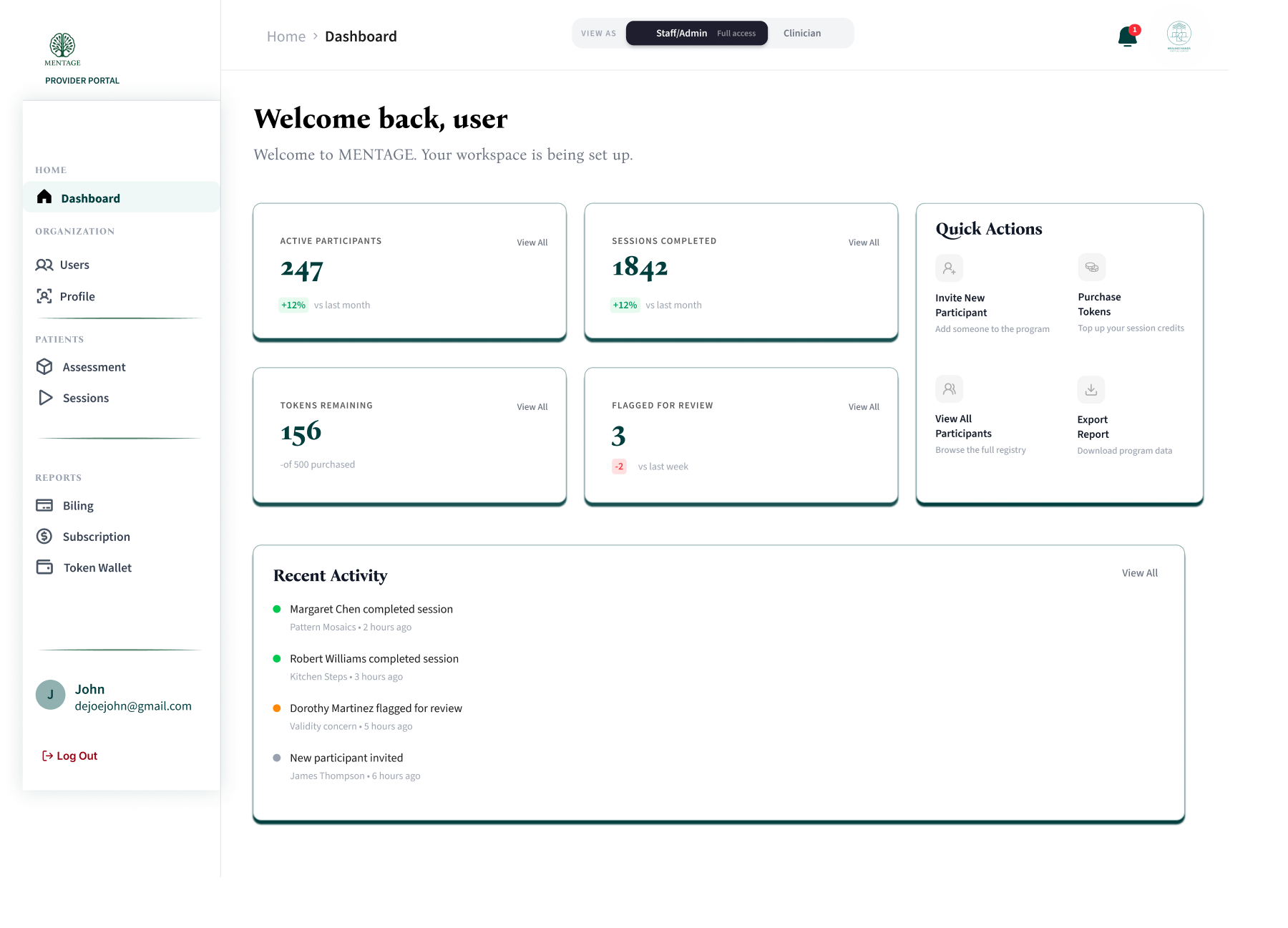
A longitudinal engagement record your patients bring to the visit, not a score from a snapshot.
Mentage is building the evidence base for a dignified, continuous approach to cognitive wellness. We are not there yet. Here is where we are.
Request a Conversation

MEVA is a general wellness tool. It does not diagnose, treat, prevent, or screen for any medical condition.

21–79%
MoCA false positive rate in ethnically diverse samples
JAGS, 2024
62.3%
of MCI cases go undetected in federally qualified health centers
JAMA, 2024
0
validated tools for tracking cognitive engagement between visits
Structural gap

That is a design problem, not a patient problem.

Standard cognitive screens were built to catch late-stage decline in clinical settings. They were not designed to track what happens between visits, in real life, over time.

A 15-minute visit provides a snapshot. Not the full picture.

It does not capture the quiet, daily changes families notice first. It does not tell a provider whether what they are seeing is a shift from last month or last year.

A documentation bridge. Not a diagnostic tool.

MEVA is a general wellness tool, not a medical device, and not intended to diagnose, treat, or screen for any medical condition. What it does is give providers and families a structured, longitudinal record of real-world cognitive engagement.

Clinical partnership study in progress.

Request a Conversation

MEVA is a general wellness tool operating under IRB-reviewed protocol. It is not FDA-cleared, not a medical device, and not intended to diagnose, treat, or screen for any medical condition.

Clinical partnership with Piedmont HealthCare currently underway. Study data expected 2027.
BRANY Independent Review Board approved.

What the Research Shows

Published research identifies three structural gaps in current cognitive wellness practice.

JAMA, 2024

Standard tools produce high false positive rates in diverse populations.

A 2024 study in the Journal of the American Geriatrics Society found that false positive rates between 21 and 79 percent in ethnically diverse samples. This is a design problem. The tools were not built for the populations now in most need of them.

JAMA, 2024

Mild cognitive impairment frequently goes undetected in high-volume primary care settings.

A 2024 JAMA study found 62.3 percent of MCI cases go undetected in federally qualified health centers. This research describes structural measurement failures. It does not establish that MEVA outcomes will improve these gaps. MEVA's clinical partnership study is currently in progress.

Clinical Observation

Families arrive at appointments with no structured longitudinal record. The clinical conversation starts from zero every time.

This research describes structural measurement failures. It does not establish that MEVA outcomes will improve these gaps. MEVA's clinical partnership study is currently in progress.

What We Can and Cannot Tell You Today

We will not tell you things we cannot yet prove.

What MEVA does today

Tracks engagement across seven real-world activities

Every session produces a structured record of how a person engaged — not a score, but a pattern across domains.

Provides longitudinal data across sessions

Week over week, the pattern builds into something a provider can actually use in conversation.

Operates under IRB-reviewed protocol

Our study design was reviewed by the BRANY Independent Review Board before any data was collected.

Has an active clinical partnership study

We are currently running a clinical study with Piedmont HealthCare. Data is expected in 2027.

What we cannot tell you yet

We cannot claim MEVA detects cognitive decline

MEVA is a general wellness tool. It does not diagnose, treat, or screen for any medical condition. We have not completed the studies that would support clinical claims.

We cannot claim MEVA improves outcomes

Our clinical partnership study is in progress. We will share results when the data is ready. We are not ready to claim clinical validity.

We cannot claim MEVA replaces clinical assessment

MEVA is a documentation bridge, not a diagnostic replacement. Always follow the guidance of your healthcare provider.

This is a design intention, not a validated clinical outcome

The six engagement bands reflect activity engagement patterns. They are not a substitute for clinical evaluation.

Is Your Practice a Good Fit?

We are not the right fit for everyone. Here is how to know.

A good pilot partner

You see older adults regularly and want better longitudinal cognitive context before visits

You are open to a 15-minute pilot conversation with no commitment

You understand this is a wellness tool, not a clinical diagnostic

You are interested in being part of an early evidence-building partnership

Not a good fit right now

You need FDA-cleared diagnostic tools for clinical decision-making

You are looking for a product with completed independent clinical trials

You cannot participate in a study that is still building its evidence base

You need a billing code or payer pathway today

Request a Conversation
WORK WITH US

A pilot conversation is 15 minutes. No pressure. No pipeline.

We will tell you exactly where we are, what the product does today, and what we are building toward. If it is not a fit, we will tell you that too.

Thank you! Your submission has been received!
Oops! Something went wrong while submitting the form.

Our Evidence Timeline

We are building the evidence base. Here is what exists today and what is coming.

Task architecture developed

Montessori-based cognitive wellness literature

Task design is grounded in published aging research with decades of evidence supporting real-world engagement approaches.

IRB-reviewed protocol

Our study design was reviewed by the BRANY Independent Review Board before any data was collected.

Active clinical studies

Piedmont HealthCare partnership study, 2026

A clinical study is currently underway. Data expected 2027. We will share results when the data is ready.

Ongoing participant data collection

We are collecting longitudinal session data under IRB protocol. No claims of clinical validity until the study is complete.

Publications and outcomes

Results publication, expected 2027

We will publish study results when data is complete and peer-reviewed. We are not ready to make clinical outcome claims today.

Independent clinical trials, planned

We have not yet completed independent clinical trials. This is a design intention, not a validated clinical outcome.